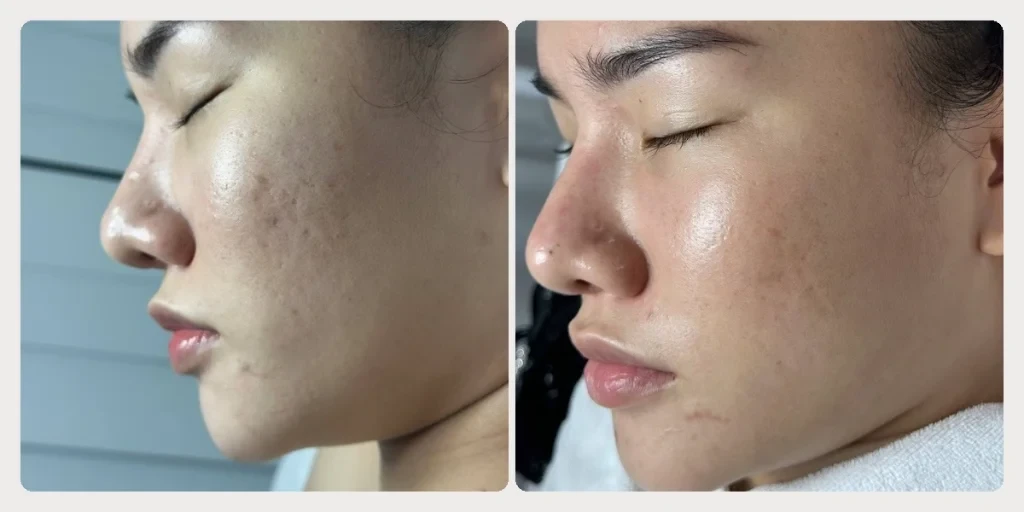
Long-standing acne scars & enlarged pores visibly smoother after 2 SkinPen® sessions in Da Nang
Real case series · Coleni Beauty · 14/07/2026
Acne scars and enlarged pores are two issues that often make people with a history of acne feel like they are “treating them forever without seeing an end.” In this case, the client had already maintained a fairly consistent skincare routine beforehand, but the skin surface still felt rough, rolling and boxcar scars remained visible, and the pores on the cheeks and nose were significantly enlarged. Her goal at Coleni Beauty was not to make the skin look instantly beautiful within a few days, but to truly improve the long-damaged skin structure through a science-based, safe treatment plan suitable for sensitive skin.
After skin analysis and scar classification, Coleni recommended SkinPen® - Microneedling in a 4-session protocol. The results recorded midway through the treatment, after 2/4 sessions: smoother skin texture, more even light reflection, visibly minimized pores, and rolling scars beginning to fill in. This is a very typical example of properly assessing the skin condition before treatment, instead of expecting at-home skincare to change deep collagen damage underneath.
Background
| Factor | Initial findings |
|---|---|
| Age | 23 years old |
| Gender | Female |
| Skin type | Acne-prone, sensitive skin |
| Main concerns | Long-standing acne scars, enlarged pores, old post-acne marks |
| Most affected areas | Cheeks, nose |
| Duration | Persisting for many years after the acne phase |
| Visible symptoms | Uneven skin surface, scattered rolling and boxcar scars, enlarged pores, uneven light reflection |
| Contributing factors | History of inflammatory acne damaging collagen; office work, frequent air-conditioned environment |
| Previous care | Consistent skincare, but no improvement in scar structure |
| Protocol at Coleni | 4 sessions of SkinPen® Microneedling |
| Reporting milestone | After 2/4 sessions |
The important point in this case is that the client was not in the group of people who had “neglected their skin and only then started treatment.” The fact that she had been caring for her skin consistently but still had scars and enlarged pores shows that the issue lies in the skin’s support structure, not simply in cleansing or moisturizing. This is also why Coleni always emphasizes the initial assessment step as explained in Understanding Your Skin: The First Step to Effective Treatment at Coleni: if the root cause is not identified correctly, it is very easy to choose the wrong treatment.
Diagnosis
Before recommending treatment, the skin was examined and analyzed by lesion type rather than grouping everything under the general term “acne scars.” This classification determines needle depth, treatment priority areas, and realistic expectations at each stage.
| Assessment item | Findings | Clinical significance |
|---|---|---|
| Rolling scars | Present, soft edges, shallow depressions scattered across the cheeks | Often respond well to microneedling because it stimulates collagen remodeling around tethered areas |
| Boxcar scars | Present, more defined edges, relatively flat bases | Require more time before obvious filling becomes visible |
| Enlarged pores | Clear on the cheeks and nose | Related to loss of collagen support around hair follicles, not simply a “genetic tendency for large pores” |
| Post-inflammatory hyperpigmentation (PIH) | Scattered | Not structural scars, but may improve indirectly as skin renewal becomes more even |
| Sensitivity level | Present | Requires process control and good post-procedure recovery |
| Honest diagnosis | Post-acne collagen structural damage, suitable for a 4-session SkinPen protocol | No expectation of completely erasing all long-standing scars after only 1–2 sessions |
The honest diagnosis here is very clear: the skin can show visible improvement after a few sessions, but there is no such thing as “completely filling in” all long-standing scars after only one treatment. Coleni chose to follow a predictable protocol instead of overpromising.
Solution
The chosen solution was SkinPen® - Microneedling, a microneedling device officially FDA-cleared in the United States for the treatment of facial acne scars in adults. In this case, choosing SkinPen matters in two ways: it is safe for sensitive skin and precise enough to target the structural layer that needs regeneration.
SkinPen works through collagen induction therapy. The device creates thousands of controlled microchannels at an appropriate depth, thereby activating the skin’s natural repair cycle:
- The initial phase is controlled inflammation, when the skin becomes red and mildly tight for 1–3 days.
- The next phase is tissue regeneration, when fibroblasts begin producing new collagen.
- The final phase is collagen remodeling over 3–6 months, when the skin gradually becomes firmer and the surface gains better support.
That is also why SkinPen is suitable for both acne scars and enlarged pores after acne. In many acne-prone cases, enlarged pores are not just about excess oil, but are the result of a weakened collagen and elastin network around the follicles. When this support layer is rebuilt, pores tend to contract more naturally.
At Coleni, this treatment does not replace cleansing or skin recovery steps when needed, but is assigned its proper role: addressing structural damage that surface-level care cannot fix. For anyone still deciding between deep cleansing, skin recovery, or microneedling, you can read How to Find the Best Facial in Da Nang for Your Skin Type to understand when the skin needs each different approach.
Procedure
The procedure in this case was standardized step by step to optimize results while minimizing unnecessary irritation.
-
Cleanse and disinfect the skin
Remove excess oil, dirt, and prepare the skin surface before the procedure. -
Apply topical numbing cream for 30–45 minutes
Helps the client feel more comfortable during treatment. -
Perform SkinPen® on the indicated areas
The technique is adjusted according to the cheeks, nose, and the severity of scarring observed on the skin. -
Apply post-procedure recovery care
Helps soothe the skin and reduce the tight, burning sensation after microneedling. -
Protect the skin before leaving
Finish with physical sunscreen SPF50+ and home-care instructions.
| Step | Content | Estimated time |
|---|---|---|
| 1 | Cleansing, disinfection | 10 minutes |
| 2 | Numbing | 30–45 minutes |
| 3 | SkinPen® Microneedling | 20–30 minutes |
| 4 | Post-treatment recovery | 15 minutes |
| 5 | Care instructions and sunscreen | Before leaving |
Total time per session is about 60–90 minutes. The interval between sessions in the protocol is 4–6 weeks so the skin has enough time to regenerate collagen between treatments.
Progress
After the first session, the client experienced redness and skin tightness for about 2 days. This is a common response and consistent with the controlled inflammation mechanism of microneedling. From day 3 onward, the skin started to feel smoother and the pores looked slightly more refined, although the acne scars had not changed much at that point.
After the second session, the difference became clearer both in real-life photos and on the skin surface under normal lighting. The cheek area reflected light more evenly, the pores no longer looked as “open” as before, the rolling scars began to soften, and the skin appeared healthier overall.
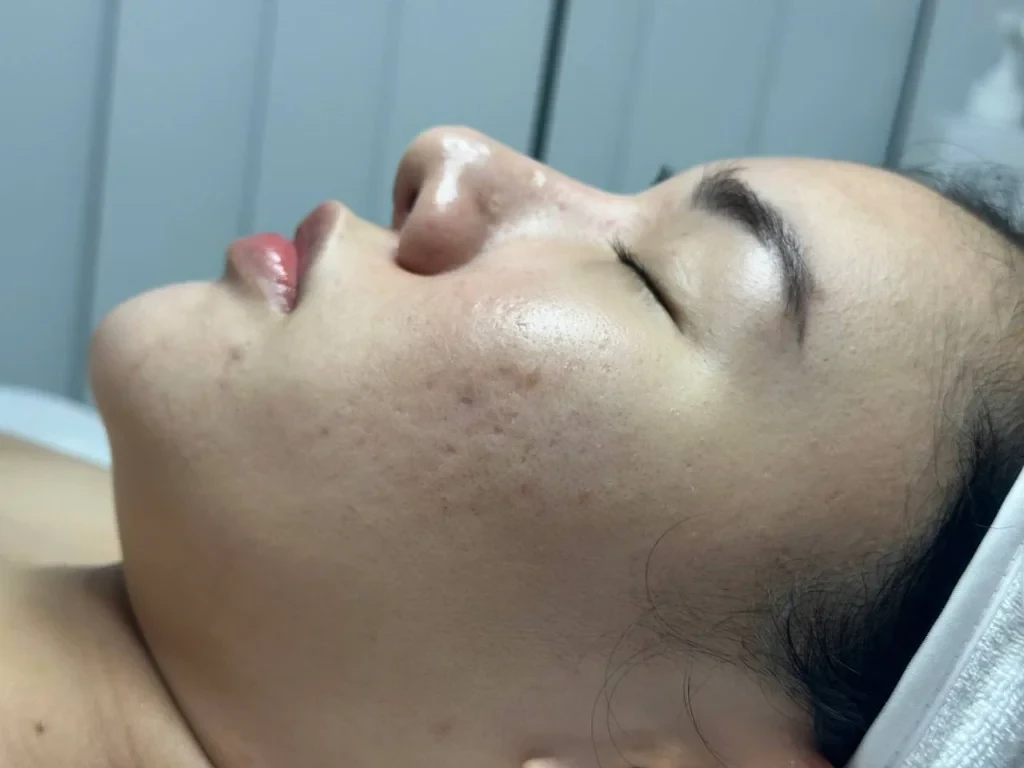
Alt: The before-treatment image shows scattered rolling and boxcar acne scars on the cheeks, visibly enlarged pores on the cheeks and nose, and an uneven skin surface with inconsistent light reflection.
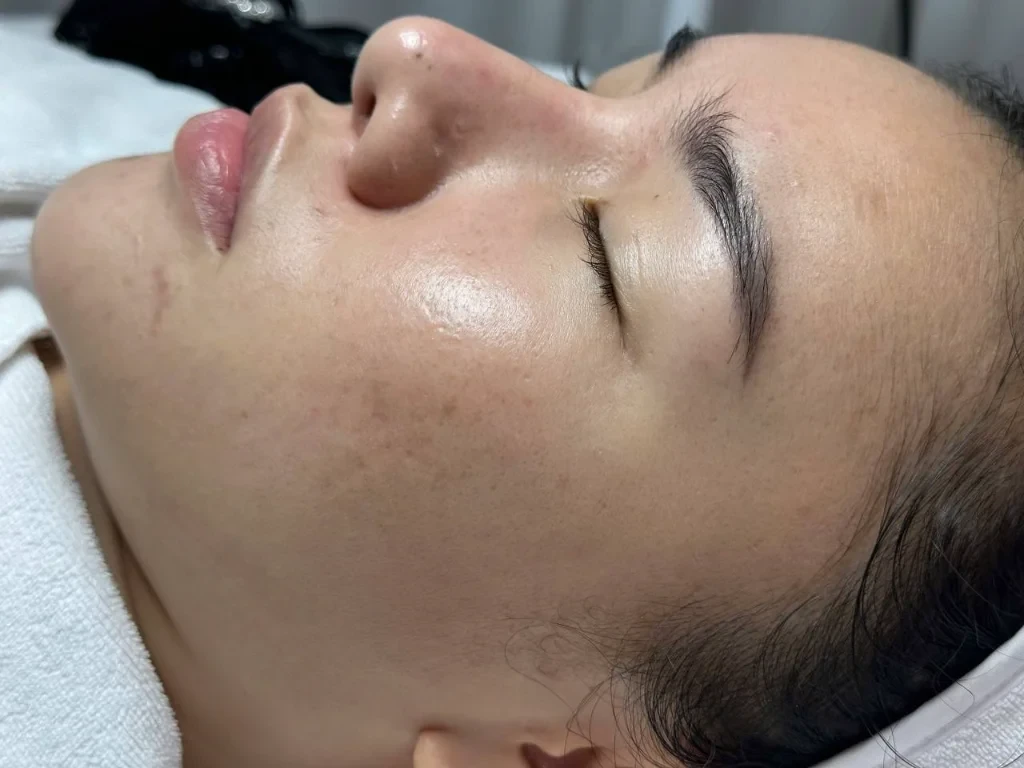
Alt: The image after 2 SkinPen sessions shows a smoother cheek skin surface, visibly smaller pores, shallower rolling scars, and overall brighter, more even skin midway through the treatment course.
It should be emphasized that this is only a mid-treatment result. With SkinPen, the most valuable change is not only what you see immediately after each session, but the collagen remodeling process that continues over the following weeks and months.
Results
| Monitoring indicator | Findings after 2/4 sessions |
|---|---|
| Pores on cheeks and nose | Significantly minimized |
| Rolling scars | Softer, with signs of the scar base filling in |
| Boxcar scars | Early improvement, but more sessions are needed for clear assessment |
| Skin texture | Smoother, more even light reflection |
| Old acne marks | Gradually fading |
| Actual downtime | 2–3 days of mild redness after each session |
| Serious side effects | None recorded |
These results come from three main factors:
- Correctly identifying the lesion type from the start: distinguishing rolling scars, boxcar scars, and enlarged pores to set the right expectations.
- Choosing the right device: SkinPen serves its proper role as controlled collagen remodeling rather than merely affecting the surface.
- Following the skin’s biological rhythm: not overdoing treatment, allowing enough recovery and restructuring time between sessions.
The recommended maintenance plan after this mid-treatment milestone is:
- Continue and complete all 4 sessions of SkinPen® - Microneedling as prescribed.
- Maintain consistent sun protection and recovery-focused home care.
- Return for follow-up on schedule to compare the progress of each scar type.
- Only consider additional supportive care steps when the skin is professionally assessed as suitable, instead of adding random treatments on your own.
If you are still unsure whether your skin needs microneedling or just cleansing and recovery first, you can also read The Best Facial in Da Nang for Acne-Prone Skin: What to Choose First. And if you want to see all available options at Coleni, you can visit the Service menu.
“Even though I had already learned beforehand that SkinPen could reduce pore size, I didn’t expect the results to be this obvious and this well-suited to my skin.”
Who is this suitable for?
- People with acne scars, especially rolling and boxcar scars
- People with enlarged pores after a prolonged phase of inflammatory acne
- People whose skin feels rough and uneven despite being quite diligent with skincare
- People who want to improve skin structure in a more sustainable way rather than chasing short-term instant effects
- People who need a method backed by clinical data and clear process control
- People with sensitive skin who still need treatment that addresses the true cause of post-acne damage
Lessons / Key takeaways
- Acne scars and enlarged pores after acne are structural issues and cannot be resolved by at-home topical cosmetics alone.
- Seeing results after 1–2 sessions is a good sign, but for long-standing scars, stronger results usually appear in the following months as collagen continues to regenerate.
- Choosing the right device and the right indication is just as important as the procedure itself.
- With microneedling, patience and following the full protocol are always more important than expecting instant change after one session.
Frequently asked questions / FAQ
Can SkinPen Microneedling treat long-standing acne scars?
Yes — SkinPen is the only microneedling device officially FDA-cleared in the United States for acne scar treatment. Long-standing acne scars require multiple sessions (typically 4–6), and results continue to improve over 3–6 months after treatment as collagen regeneration continues.
How many SkinPen sessions are needed to see results for acne scars?
Usually 3–6 sessions for optimal results, spaced 4–6 weeks apart. Initial improvement may be seen after 1–2 sessions. More obvious changes usually appear from session 3 onward. Collagen continues to regenerate for 3–6 months after each treatment session.
Does SkinPen Microneedling hurt? Can I go back to work right after treatment?
With numbing cream applied for 30–45 minutes beforehand, most clients only feel mild stinging similar to surface scratches. After treatment, the skin stays red and tight for 1–3 days — most people can return to normal activities within 24–72 hours.
How is SkinPen different from standard microneedling devices?
SkinPen is the ONLY microneedling device FDA-cleared as a Class II device in the United States (De Novo DEN160029) for treating acne scars and neck wrinkles. Standard devices do not have independent clinical data, are not validated for needle depth, and do not have a cross-contamination prevention system. This difference directly affects both safety and effectiveness.
Treatment results may vary depending on scar type, degree of collagen damage, individual skin response, and adherence to post-treatment care. The images in this article were recorded after 2/4 sessions and do not reflect the final result of the full treatment course.
If you are interested in treating acne scars or enlarged pores at Coleni Beauty, start with a skin analysis session and a proper assessment before choosing a method. View services, book an appointment, and choose a suitable time slot at the Service menu.